Read through by Dr. Kkomal Vasisht
This is the clearest case for why the trade settles the question somewhere other than the surface.
In short
This is the clearest case for why the trade settles the question somewhere other than the surface. It is also where the money involved makes careful faking worthwhile — and careful work photographs well.
At twelve faces and above, two experienced people can count the same bead and reach different numbers. The grooves sit close enough together that whether a faint line counts becomes a judgement rather than an observation.
This page covers the 12, 13 and 14 Mukhi — what each one is, how each is imitated, what the tradition holds, and what to ask before you pay. What is true of every Rudraksha — what the beads are, how verification works, which popular tests do not — is set out in full in the Rudraksha buying guide.
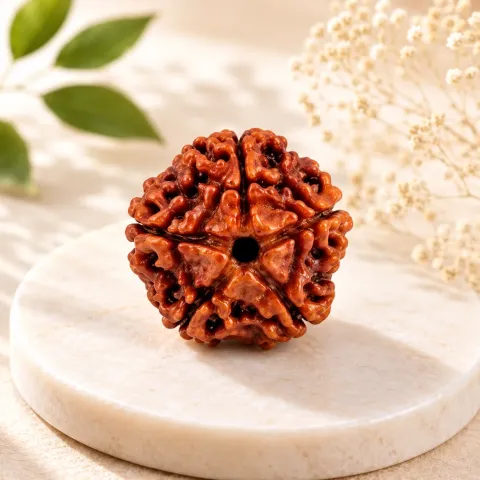
The most-worn Rudraksha, associated with peace and wellbeing. Lab-tested, Nepali origin.
₹899.00
Not in stock just now
View this pieceWhy these counts belong on one page
These counts share a situation. What a buyer needs to know at 12 faces is very largely what they need to know at 14, and the differences between them are set out below, each under its own heading.
12, 13 and 14 Mukhi
covered here
Uncommon
to rare
16–30 mm
typical range
One scan
settles any of them
12 Mukhi (Barah) Rudraksha
A 12 Mukhi has twelve clefts running from top to bottom and twelve chambers inside to match. It is uncommon among Rudraksha, and above the 11, commonly found at 16–30 mm, and is worn singly.
Where two honest people disagree
At twelve faces, whether a faint line counts as a groove becomes a judgement, and two experienced people can reach different numbers on the same bead. This is the clearest case for why the chamber count rather than the surface is what the trade settles on.
How a 12 Mukhi is imitated
Yes, routinely. Extra grooves are cut into a cheaper bead, the cuts are smoothed and darkened, and the result passes a look.
Twelve clefts. Two sellers can count the same bead differently at this point, which is one more reason the chamber count rather than the surface is what decides it.
What the tradition holds for the 12 Mukhi
In Vedic and Puranic tradition — the Shiva Purana, the Padma Purana and the Devi Bhagavata among them — the 12 Mukhi is associated with the twelve Adityas and with Surya (the Sun). The qualities described are radiance, leadership, vitality.
If you are buying a 12 Mukhi
The seller says twelve, your friend who knows says eleven, and both seem sure. At this count that situation resolves in a particular way: the scan is the only thing that settles it, and it costs a fraction of the bead. Ask for the count in writing, ask which country it grew in, and ask for photographs from more than one side. All three are reasonable requests and how they are received tells you most of what you need.
13 Mukhi (Terah) Rudraksha
A 13 Mukhi has thirteen clefts running from top to bottom and thirteen chambers inside to match. It is rare among Rudraksha, and a large step above the 12, commonly found at 16–30 mm, and is worn singly, usually capped.
Stop buying from photographs
The money involved at thirteen makes careful work worthwhile for somebody willing to do it, and careful work photographs well. A scan with a number you can look up, or nothing — that is the honest advice at this count and it costs a sale to give it.
How a 13 Mukhi is imitated
Yes, and the money involved makes it worth doing carefully.
Thirteen clefts. Do not buy on photographs at this count. A scan, with a report number you can look up, or nothing.
What the tradition holds for the 13 Mukhi
In Vedic and Puranic tradition — the Shiva Purana, the Padma Purana and the Devi Bhagavata among them — the 13 Mukhi is associated with Kamadeva, and Indra and with Shukra (Venus). The qualities described are charm, fulfilment of wishes, attraction.
If you are buying a 13 Mukhi
You have found a seller with several at this count and good prices. At this count that situation resolves in a particular way: the scan is the only thing that settles it, and it costs a fraction of the bead. Ask for the count in writing, ask which country it grew in, and ask for photographs from more than one side. All three are reasonable requests and how they are received tells you most of what you need.
14 Mukhi (Chaudah) Rudraksha
A 14 Mukhi has fourteen clefts running from top to bottom and fourteen chambers inside to match. It is rare among Rudraksha, and among the more expensive counts, commonly found at 18–32 mm, and is worn singly, almost always capped.
The most wanted of the findable counts
Fourteen sits at an awkward point: rare enough to command a real price, but not so rare that supply is obviously impossible. That makes it the count where a plausible-looking offer at a plausible-looking price deserves the most suspicion, not the least.
How a 14 Mukhi is imitated
Yes, thoroughly.
Fourteen clefts. Anything at this count offered at a price that seems reasonable is the thing to be most careful about.
What the tradition holds for the 14 Mukhi
In Vedic and Puranic tradition — the Shiva Purana, the Padma Purana and the Devi Bhagavata among them — the 14 Mukhi is associated with Hanuman and with Shani (Saturn). The qualities described are intuition, decisiveness, protection.
Often described as the most prized of the commonly available counts.
If you are buying a 14 Mukhi
The offer is plausible in every respect, which is what is bothering you. At this count that situation resolves in a particular way: the scan is the only thing that settles it, and it costs a fraction of the bead. Ask for the count in writing, ask which country it grew in, and ask for photographs from more than one side. All three are reasonable requests and how they are received tells you most of what you need.
Verifying any of these
One method works for all of them: an X-ray or CT scan, which shows the chambers directly. The count on the outside should match the chambers inside, and carving cannot change the chambers because they formed years before anybody picked up a tool.
Ask for the scan image rather than only the report — a report can be written about a different bead — and look the number up on the laboratory’s own site. The water test, the coin test, the milk test and the boiling test are all repeated widely and none of them works. Why each of them fails.
Before you pay
- ✓The species, named in writingElaeocarpus ganitrus
- ✓The count, put in writing
- ✓Where it grewNepal, India or Indonesia
- ✓The size in millimetres
- ✓A scan image showing the chambersNot only the report
- ✓A report number you can look upOn the laboratory's own site
- ✓Photographs from several sides
- ✓The return termsBefore paying, not after
What decides the price at these counts
- Whether it is genuinely the count it is sold as. This outweighs everything else.
- Where it grew. Nepali costs more than Indonesian, size for size.
- Size. Gentle to about 20 mm, steep after that.
- Condition of the grooves — unbroken, unrepaired, not filled.
- Whether a laboratory report comes with it, and from which laboratory.
| Grade | What it means | Typically |
|---|---|---|
| 12 Mukhi | ||
| 13 Mukhi | ||
| 14 Mukhi |
Ranges rather than quotations.
Looking after one
A Rudraksha is seed material and behaves like wood rather than stone: keep it away from soap and chlorinated water, take it off before bathing, and oil it lightly every few months. Worn regularly it looks after itself; put away in a drawer it can dry out and crack. Care and storage in full.
Questions people ask
How do I tell a genuine 12 Mukhi from a carved one?
Why are 12, 13 and 14 Mukhi prices so different from each other?
Which planet is the 12 Mukhi associated with?
Which planet is the 13 Mukhi associated with?
Which planet is the 14 Mukhi associated with?
Does a genuine Rudraksha sink in water?
Is a certificate worth paying extra for?
What is the difference between Nepali and Java beads?
Can I wear it in the shower?
Which of the 12, 13 and 14 Mukhi do you stock, and at what price?
Sources
- Elaeocarpus ganitrus — Plants of the World Online, Kew ↗ · academic
- Shiva Purana, Vidyeshvara Samhita · other
- Devi Bhagavata Purana, Book 11 · other
Traditional and astrological associations described on this page are matters of belief, not established fact. Nothing here is medical advice. Rudraksha beads are not a treatment for any condition.