Read through by Dr. Kkomal Vasisht
Both of those are worth saying out loud rather than papering over.
In short
Both of those are worth saying out loud rather than papering over. A page that claims certainty about a 17 Mukhi’s tradition, or offers several of them in stock, is claiming more than the subject supports.
Above fourteen faces two things happen at once. The texts and the living lineages start to disagree about what these counts mean, and the number of genuine beads reaching the market each year falls to something countable rather than estimable.
This page covers the 15, 16, 17 and 18 Mukhi — what each one is, how each is imitated, what the tradition holds, and what to ask before you pay. What is true of every Rudraksha — what the beads are, how verification works, which popular tests do not — is set out in full in the Rudraksha buying guide.
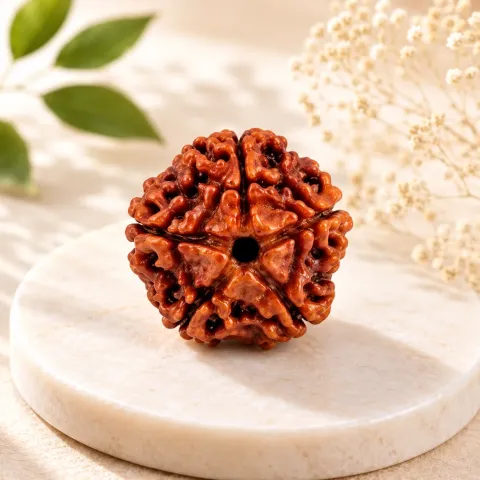
The most-worn Rudraksha, associated with peace and wellbeing. Lab-tested, Nepali origin.
₹899.00
Not in stock just now
View this pieceWhy these counts belong on one page
A 16 Mukhi and a 17 Mukhi are not two subjects. They are the same seed with one more groove, and almost everything true of one is true of the other. Splitting them across separate pages would mean writing the same page twice and asking you to read it twice.
15, 16, 17 and 18 Mukhi
covered here
Very rare
to very rare
18–32 mm
typical range
One scan
settles any of them
15 Mukhi (Pandrah) Rudraksha
A 15 Mukhi has fifteen clefts running from top to bottom and fifteen chambers inside to match. It is very rare among Rudraksha, and high, commonly found at 18–32 mm, and is worn singly.
Where the written tradition thins out
Above fourteen faces the texts and the living lineages start to diverge, and so does the market. Fewer genuine beads reach it each year than are sold in a month, and the gap is filled by carving.
How a 15 Mukhi is imitated
Yes. At this count the money involved makes careful work worthwhile, and careful work photographs well.
Fifteen clefts. Beyond fourteen, the number of genuine beads reaching the market in a year is small enough that a seller with several in stock is worth asking where they came from.
What the tradition holds for the 15 Mukhi
In Vedic and Puranic tradition — the Shiva Purana, the Padma Purana and the Devi Bhagavata among them — the 15 Mukhi is associated with Pashupati, a form of Shiva and with sources differ. The qualities described are described in terms of devotion and single-mindedness.
The sources differ at this count. Above fourteen faces the texts and the living lineages diverge, and what is written here is the most widely followed reading rather than the only one.
If you are buying a 15 Mukhi
You have read three sources on what this count means and they do not agree. At this count that situation resolves in a particular way: the scan is the only thing that settles it, and it costs a fraction of the bead. Ask for the count in writing, ask which country it grew in, and ask for photographs from more than one side. All three are reasonable requests and how they are received tells you most of what you need.
16 Mukhi (Solah) Rudraksha
A 16 Mukhi has sixteen clefts running from top to bottom and sixteen chambers inside to match. It is very rare among Rudraksha, and high, commonly found at 18–32 mm, and is worn singly.
The report, not the image
Ask for the scan image rather than only the report. A report can be written about a different bead; an image of a bead with sixteen chambers is an image of that bead. At this count that distinction is worth insisting on.
How a 16 Mukhi is imitated
Yes, and thoroughly. Sixteen grooves sit close enough together that a carver has to be good, which means the ones reaching the market are the ones done well.
Sixteen clefts, sixteen chambers. The scan is not optional at this count.
What the tradition holds for the 16 Mukhi
In Vedic and Puranic tradition — the Shiva Purana, the Padma Purana and the Devi Bhagavata among them — the 16 Mukhi is associated with Ram, and Mahakal and with sources differ. The qualities described are described in terms of protection and freedom from fear.
The sources differ at this count. Above fourteen faces the texts and the living lineages diverge, and what is written here is the most widely followed reading rather than the only one.
Sources differ at this count. Some lineages read it quite differently.
If you are buying a 16 Mukhi
The report arrives as a PDF with no image of the scan. At this count that situation resolves in a particular way: the scan is the only thing that settles it, and it costs a fraction of the bead. Ask for the count in writing, ask which country it grew in, and ask for photographs from more than one side. All three are reasonable requests and how they are received tells you most of what you need.
17 Mukhi (Satrah) Rudraksha
A 17 Mukhi has seventeen clefts running from top to bottom and seventeen chambers inside to match. It is very rare among Rudraksha, and high, commonly found at 18–32 mm, and is worn singly.
A number nobody can check by looking
Seventeen grooves on a bead of thirty millimetres are close enough that counting from a photograph is unreliable even with good pictures. The surface has stopped being evidence here, and only the inside is.
How a 17 Mukhi is imitated
Yes. By seventeen faces the surface has stopped being evidence, and a carved bead is as convincing as a real one to anybody working from photographs.
Seventeen clefts. Ask for the scan image, not only the report: a report can be written about a different bead, an image cannot.
What the tradition holds for the 17 Mukhi
In Vedic and Puranic tradition — the Shiva Purana, the Padma Purana and the Devi Bhagavata among them — the 17 Mukhi is associated with Katyayani, a form of Devi and with sources differ. The qualities described are described in terms of attainment and of unexpected gain.
The sources differ at this count. Above fourteen faces the texts and the living lineages diverge, and what is written here is the most widely followed reading rather than the only one.
If you are buying a 17 Mukhi
You cannot count the grooves from the photographs and the seller says trust them. At this count that situation resolves in a particular way: the scan is the only thing that settles it, and it costs a fraction of the bead. Ask for the count in writing, ask which country it grew in, and ask for photographs from more than one side. All three are reasonable requests and how they are received tells you most of what you need.
18 Mukhi (Atharah) Rudraksha
An 18 Mukhi has eighteen clefts running from top to bottom and eighteen chambers inside to match. It is very rare among Rudraksha, and high, commonly found at 18–34 mm, and is worn singly.
Where scarcity stops being a spectrum
By eighteen faces the number of genuine beads reaching the market in a year is small enough to be counted rather than estimated. Anything offered at this count should be approached as an exception that has to prove itself.
How an 18 Mukhi is imitated
Yes. At eighteen faces almost everything offered is carved, and the few genuine beads that exist rarely reach an open listing.
Eighteen clefts. At this point the lines are so close that counting from a photograph is unreliable, and the chamber count is the only count that matters.
What the tradition holds for the 18 Mukhi
In Vedic and Puranic tradition — the Shiva Purana, the Padma Purana and the Devi Bhagavata among them — the 18 Mukhi is associated with Bhumi Devi, the earth and with sources differ. The qualities described are described in terms of grounding, land, and stability.
The sources differ at this count. Above fourteen faces the texts and the living lineages diverge, and what is written here is the most widely followed reading rather than the only one.
If you are buying an 18 Mukhi
You are about to make the largest purchase you have made from a website. At this count that situation resolves in a particular way: the scan is the only thing that settles it, and it costs a fraction of the bead. Ask for the count in writing, ask which country it grew in, and ask for photographs from more than one side. All three are reasonable requests and how they are received tells you most of what you need.
Verifying any of these
One method works for all of them: an X-ray or CT scan, which shows the chambers directly. The count on the outside should match the chambers inside, and carving cannot change the chambers because they formed years before anybody picked up a tool.
Ask for the scan image rather than only the report — a report can be written about a different bead — and look the number up on the laboratory’s own site. The water test, the coin test, the milk test and the boiling test are all repeated widely and none of them works. Why each of them fails.
Before you pay
- ✓The species, named in writingElaeocarpus ganitrus
- ✓The count, put in writing
- ✓Where it grewNepal, India or Indonesia
- ✓The size in millimetres
- ✓A scan image showing the chambersNot only the report
- ✓A report number you can look upOn the laboratory's own site
- ✓Photographs from several sides
- ✓The return termsBefore paying, not after
What decides the price at these counts
- Whether it is genuinely the count it is sold as. This outweighs everything else.
- Where it grew. Nepali costs more than Indonesian, size for size.
- Size. Gentle to about 20 mm, steep after that.
- Condition of the grooves — unbroken, unrepaired, not filled.
- Whether a laboratory report comes with it, and from which laboratory.
| Grade | What it means | Typically |
|---|---|---|
| 15 Mukhi | ||
| 16 Mukhi | ||
| 17 Mukhi | ||
| 18 Mukhi |
Ranges rather than quotations.
Looking after one
A Rudraksha is seed material and behaves like wood rather than stone: keep it away from soap and chlorinated water, take it off before bathing, and oil it lightly every few months. Worn regularly it looks after itself; put away in a drawer it can dry out and crack. Care and storage in full.
Questions people ask
How do I tell a genuine 15 Mukhi from a carved one?
Why are 15, 16, 17 and 18 Mukhi prices so different from each other?
Which planet is the 15 Mukhi associated with?
Which planet is the 16 Mukhi associated with?
Which planet is the 17 Mukhi associated with?
Which planet is the 18 Mukhi associated with?
Does a genuine Rudraksha sink in water?
Is a certificate worth paying extra for?
What is the difference between Nepali and Java beads?
Can I wear it in the shower?
Sources
- Elaeocarpus ganitrus — Plants of the World Online, Kew ↗ · academic
- Shiva Purana, Vidyeshvara Samhita · other
- Devi Bhagavata Purana, Book 11 · other
Traditional and astrological associations described on this page are matters of belief, not established fact. Nothing here is medical advice. Rudraksha beads are not a treatment for any condition.
read ok