Read through by Dr. Kkomal Vasisht
By ten faces, assume a bead is a 5 Mukhi with extra lines until something says otherwise, and price it that way in your own head while you decide.
In short
By ten faces, assume a bead is a 5 Mukhi with extra lines until something says otherwise, and price it that way in your own head while you decide. That is not cynicism — it is the base rate, and a buyer who starts anywhere else starts wrong.
Somewhere in this range the sensible starting assumption flips. Below it, a bead without a report is probably what it says. Within it, the arithmetic of how many beads exist against how many are advertised stops supporting that.
This page covers the 8, 9, 10 and 11 Mukhi — what each one is, how each is imitated, what the tradition holds, and what to ask before you pay. What is true of every Rudraksha — what the beads are, how verification works, which popular tests do not — is set out in full in the Rudraksha buying guide.
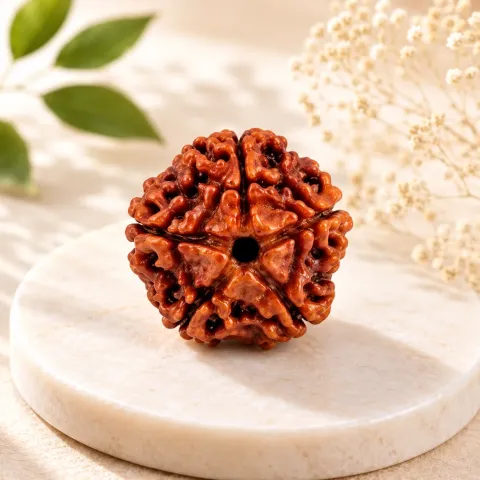
The most-worn Rudraksha, associated with peace and wellbeing. Lab-tested, Nepali origin.
₹899.00
Not in stock just now
View this pieceWhy these counts belong on one page
These counts share a situation. What a buyer needs to know at 8 faces is very largely what they need to know at 11, and the differences between them are set out below, each under its own heading.
8, 9, 10 and 11 Mukhi
covered here
Less common
to uncommon
14–26 mm
typical range
One scan
settles any of them
8 Mukhi (Aath) Rudraksha
An 8 Mukhi has eight clefts running from top to bottom and eight chambers inside to match. It is less common among Rudraksha, and noticeably above the 7, commonly found at 14–26 mm, and is worn singly.
Where the lines start to crowd
Eight grooves on a bead the size of a thumbnail sit close enough together that carving one more in is difficult to do neatly. Carved lines at this count often run straighter than the curve of the bead, because a straight cut is easier than a curved one.
How an 8 Mukhi is imitated
Yes. Routinely.
Eight clefts. At this count the lines sit close together, and a carved one is easier to spot: natural clefts curve with the bead, carved lines run straighter.
What the tradition holds for the 8 Mukhi
In Vedic and Puranic tradition — the Shiva Purana, the Padma Purana and the Devi Bhagavata among them — the 8 Mukhi is associated with Ganesha and with Rahu. The qualities described are removal of obstacles, clear beginnings.
If you are buying an 8 Mukhi
You have two beads in front of you and one costs twice the other. At this count that situation resolves in a particular way: the scan is the only thing that settles it, and it costs a fraction of the bead. Ask for the count in writing, ask which country it grew in, and ask for photographs from more than one side. All three are reasonable requests and how they are received tells you most of what you need.
9 Mukhi (Nau) Rudraksha
A 9 Mukhi has nine clefts running from top to bottom and nine chambers inside to match. It is less common among Rudraksha, and above the 8, commonly found at 14–28 mm, and is worn singly.
The count carvers have got good at
Nine is common enough to be wanted and valuable enough to be worth the work, which is the combination that produces skilled fakes. Expect the surface to look right. A bead here that is glossier than an untreated bead should be has usually been oiled to hide tool marks.
How a 9 Mukhi is imitated
Yes, and increasingly well. A good carver can make a convincing 9.
Nine clefts. The surface between lines should have the same texture throughout; a carved bead is often smoothed or oiled to hide the tool marks, which leaves it glossier than an untreated bead should be.
What the tradition holds for the 9 Mukhi
In Vedic and Puranic tradition — the Shiva Purana, the Padma Purana and the Devi Bhagavata among them — the 9 Mukhi is associated with Durga and with Ketu. The qualities described are courage, protection, energy.
Traditionally worn on the left arm rather than at the throat.
If you are buying a 9 Mukhi
The bead looks better than the price suggests it should. At this count that situation resolves in a particular way: the scan is the only thing that settles it, and it costs a fraction of the bead. Ask for the count in writing, ask which country it grew in, and ask for photographs from more than one side. All three are reasonable requests and how they are received tells you most of what you need.
10 Mukhi (Das) Rudraksha
A 10 Mukhi has ten clefts running from top to bottom and ten chambers inside to match. It is uncommon among Rudraksha, and a step above the 9, commonly found at 15–28 mm, and is worn singly.
Where the honest default changes
Below this count, a bead without a report is probably what it says. At ten and above, the sensible default flips: assume it is a 5 Mukhi with extra lines until something says otherwise, and price it that way in your own head while you decide.
How a 10 Mukhi is imitated
Yes. Assume it until a scan says otherwise.
Ten clefts, ten chambers. At this count and above, a bead without a laboratory report should be priced as though it were a 5 Mukhi, because that is what it might be.
What the tradition holds for the 10 Mukhi
In Vedic and Puranic tradition — the Shiva Purana, the Padma Purana and the Devi Bhagavata among them — the 10 Mukhi is associated with Vishnu and with no single ruling planet is assigned. The qualities described are protection, peace of mind.
One of the few counts the tradition describes as not ruled by a particular graha.
If you are buying a 10 Mukhi
You are about to spend a sum you would notice, on a photograph. At this count that situation resolves in a particular way: the scan is the only thing that settles it, and it costs a fraction of the bead. Ask for the count in writing, ask which country it grew in, and ask for photographs from more than one side. All three are reasonable requests and how they are received tells you most of what you need.
11 Mukhi (Gyarah) Rudraksha
An 11 Mukhi has eleven clefts running from top to bottom and eleven chambers inside to match. It is uncommon among Rudraksha, and well above the 10, commonly found at 16–30 mm, and is worn singly, often capped.
Too many to count by eye
Eleven grooves cannot be counted reliably by turning a bead in your hand — people lose their place and count one twice. Photograph it from four sides and count from the pictures. Two sellers counting the same bead differently is common here and it is not always dishonesty.
How an 11 Mukhi is imitated
Yes, commonly.
Eleven clefts. The count itself becomes hard to do by eye here — photograph the bead and count from the picture, turning it as you go.
What the tradition holds for the 11 Mukhi
In Vedic and Puranic tradition — the Shiva Purana, the Padma Purana and the Devi Bhagavata among them — the 11 Mukhi is associated with Hanuman, and the eleven Rudras and with no single ruling planet is assigned. The qualities described are strength, steadiness, courage.
If you are buying an 11 Mukhi
You have counted the grooves twice and got different numbers. At this count that situation resolves in a particular way: the scan is the only thing that settles it, and it costs a fraction of the bead. Ask for the count in writing, ask which country it grew in, and ask for photographs from more than one side. All three are reasonable requests and how they are received tells you most of what you need.
Verifying any of these
One method works for all of them: an X-ray or CT scan, which shows the chambers directly. The count on the outside should match the chambers inside, and carving cannot change the chambers because they formed years before anybody picked up a tool.
Ask for the scan image rather than only the report — a report can be written about a different bead — and look the number up on the laboratory’s own site. The water test, the coin test, the milk test and the boiling test are all repeated widely and none of them works. Why each of them fails.
Before you pay
- ✓The species, named in writingElaeocarpus ganitrus
- ✓The count, put in writing
- ✓Where it grewNepal, India or Indonesia
- ✓The size in millimetres
- ✓A scan image showing the chambersNot only the report
- ✓A report number you can look upOn the laboratory's own site
- ✓Photographs from several sides
- ✓The return termsBefore paying, not after
What decides the price at these counts
- Whether it is genuinely the count it is sold as. This outweighs everything else.
- Where it grew. Nepali costs more than Indonesian, size for size.
- Size. Gentle to about 20 mm, steep after that.
- Condition of the grooves — unbroken, unrepaired, not filled.
- Whether a laboratory report comes with it, and from which laboratory.
| Grade | What it means | Typically |
|---|---|---|
| 8 Mukhi | ||
| 9 Mukhi | ||
| 10 Mukhi | ||
| 11 Mukhi |
Ranges rather than quotations.
Looking after one
A Rudraksha is seed material and behaves like wood rather than stone: keep it away from soap and chlorinated water, take it off before bathing, and oil it lightly every few months. Worn regularly it looks after itself; put away in a drawer it can dry out and crack. Care and storage in full.
Questions people ask
How do I tell a genuine 8 Mukhi from a carved one?
Why are 8, 9, 10 and 11 Mukhi prices so different from each other?
Which planet is the 8 Mukhi associated with?
Which planet is the 9 Mukhi associated with?
Which planet is the 10 Mukhi associated with?
Which planet is the 11 Mukhi associated with?
Does a genuine Rudraksha sink in water?
Is a certificate worth paying extra for?
What is the difference between Nepali and Java beads?
Can I wear it in the shower?
Which of the 8, 9, 10 and 11 Mukhi do you stock, and at what price?
Sources
- Elaeocarpus ganitrus — Plants of the World Online, Kew ↗ · academic
- Shiva Purana, Vidyeshvara Samhita · other
- Devi Bhagavata Purana, Book 11 · other
Traditional and astrological associations described on this page are matters of belief, not established fact. Nothing here is medical advice. Rudraksha beads are not a treatment for any condition.