
Read through by Dr. Kkomal Vasisht
The round Nepali bead and the half-moon South Indian bead are sold under one name. Neither is fake. They are different things, and the price gap between them is wider than any other gap in Rudraksha.
In short
The round Nepali bead and the half-moon South Indian bead are sold under one name. Neither is fake. They are different things, and the price gap between them is wider than any other gap in Rudraksha.
Nobody arrives at the 1 Mukhi by accident. It is the count people have heard of and the one they have usually been warned about, and both of those are earned. It is also the only count where the first question is not how many faces the bead has — it is which of two different species you are being shown.
This page covers the 1 Mukhi — what each one is, how it is imitated, what the tradition holds, and what to ask before you pay. What is true of every Rudraksha — what the beads are, how verification works, which popular tests do not — is set out in full in the Rudraksha buying guide.
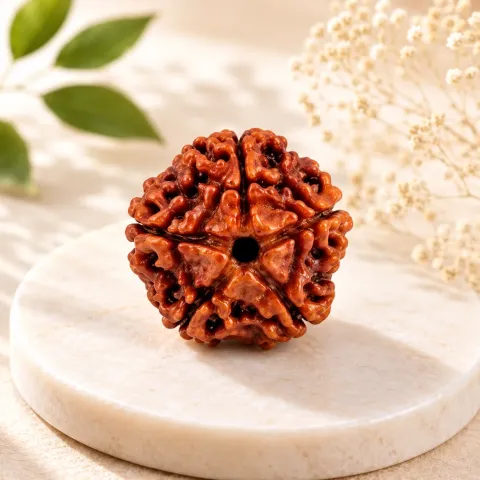
The most-worn Rudraksha, associated with peace and wellbeing. Lab-tested, Nepali origin.
₹899.00
Not in stock just now
View this piece1 Mukhi
covered here
Extremely rare in the round nepali form
to extremely rare in the round Nepali form
18–30 mm
typical range
One scan
settles any of them
1 Mukhi (Ek) Rudraksha
A 1 Mukhi has one clefts running from top to bottom and one chambers inside to match. It is extremely rare in the round Nepali form among Rudraksha, and priced accordingly, commonly found at 18–30 mm, and is worn singly, almost always capped.
Two species, one name
The round Nepali bead and the half-moon South Indian bead are different species sold under one name. Everything else about buying a 1 Mukhi follows from which of the two is in front of you, and the price gap between them is wider than any other gap on this list.
How a 1 Mukhi is imitated
Constantly, and in a way peculiar to this count: the half-moon South Indian bead is a different species sold under the same name. That is not always deception — it is a genuine traditional bead — but the price gap between the two is wider than any other gap in Rudraksha.
Shape first. The round Nepali form and the half-moon form look nothing alike once you have seen both. After that, a single cleft running unbroken from hole to hole, and one chamber on a scan.
What the tradition holds for the 1 Mukhi
In Vedic and Puranic tradition — the Shiva Purana, the Padma Purana and the Devi Bhagavata among them — the 1 Mukhi is associated with Shiva and with Surya (the Sun). The qualities described are focus, detachment, clarity of purpose.
The most consistently described of all the counts.
If you are buying a 1 Mukhi
Somebody sends you a photograph of a bead at ninety thousand rupees and another at nine hundred, and both listings say the same words. At this count that situation resolves in a particular way: the bead is cheap enough that the risk is small, and the usual error is an honest one rather than a deception. Ask for the count in writing, ask which country it grew in, and ask for photographs from more than one side. All three are reasonable requests and how they are received tells you most of what you need.
Verifying any of these
One method works for all of them: an X-ray or CT scan, which shows the chambers directly. The count on the outside should match the chambers inside, and carving cannot change the chambers because they formed years before anybody picked up a tool.
Ask for the scan image rather than only the report — a report can be written about a different bead — and look the number up on the laboratory’s own site. The water test, the coin test, the milk test and the boiling test are all repeated widely and none of them works. Why each of them fails.
Before you pay
- ✓The species, named in writingElaeocarpus ganitrus
- ✓The count, put in writing
- ✓Where it grewNepal, India or Indonesia
- ✓The size in millimetres
- ✓A scan image showing the chambersNot only the report
- ✓A report number you can look upOn the laboratory's own site
- ✓Photographs from several sides
- ✓The return termsBefore paying, not after
What decides the price at these counts
- Whether it is genuinely the count it is sold as. This outweighs everything else.
- Where it grew. Nepali costs more than Indonesian, size for size.
- Size. Gentle to about 20 mm, steep after that.
- Condition of the grooves — unbroken, unrepaired, not filled.
- Whether a laboratory report comes with it, and from which laboratory.
| Grade | What it means | Typically |
|---|---|---|
| 1 Mukhi |
Ranges rather than quotations.
Looking after one
A Rudraksha is seed material and behaves like wood rather than stone: keep it away from soap and chlorinated water, take it off before bathing, and oil it lightly every few months. Worn regularly it looks after itself; put away in a drawer it can dry out and crack. Care and storage in full.
Questions people ask
How do I tell a genuine 1 Mukhi from a carved one?
Why are 1 Mukhi prices so different from each other?
Which planet is the 1 Mukhi associated with?
Does a genuine Rudraksha sink in water?
Is a certificate worth paying extra for?
What is the difference between Nepali and Java beads?
Can I wear it in the shower?
Which of the 1 Mukhi do you stock, and at what price?
Sources
- Elaeocarpus ganitrus — Plants of the World Online, Kew ↗ · academic
- Shiva Purana, Vidyeshvara Samhita · other
- Devi Bhagavata Purana, Book 11 · other
Traditional and astrological associations described on this page are matters of belief, not established fact. Nothing here is medical advice. Rudraksha beads are not a treatment for any condition.